

Can You Have a Gastric Bypass at a BMI of 21? Treating Severe GERD After Gastric Sleeve
A patient recently contacted our bariatric surgery team with an unusual but important question.
She had undergone gastric sleeve surgery several years earlier. Before surgery, she weighed approximately 188 pounds at 5’2”, corresponding to a BMI of approximately 34.
Today, she weighs approximately 117 pounds, with a BMI of 21.5. From a weight-loss perspective, her bariatric surgery was very successful.
But she now faces a very different problem: Severe gastroesophageal reflux disease (GERD) that is no longer adequately controlled with medication.
She had been told that conversion from gastric sleeve to gastric bypass might be the surgical solution. That raises an important question: Why would we consider a gastric bypass in someone who weighs only 117 pounds?
The answer illustrates one of the most important principles of revisional bariatric surgery:
"Not every gastric bypass is performed for weight loss. In selected patients, conversion from sleeve gastrectomy to Roux-en-Y gastric bypass may be considered primarily to treat complications of the original operation—particularly severe, medically refractory GERD."
But at a BMI of 21.5, the decision requires much more than simply saying, “You have reflux, so let’s convert your sleeve to a bypass.” The first question should be: Why is this patient experiencing severe reflux?
GERD After Gastric Sleeve: A Recognized Long-Term Problem
Sleeve gastrectomy is one of the most commonly performed bariatric operations worldwide and can provide excellent long-term weight-loss and metabolic outcomes.
However, gastroesophageal reflux is a recognized concern following sleeve gastrectomy. Long-term randomized data have shown that worsening or newly developed GERD occurs more frequently after sleeve gastrectomy than after Roux-en-Y gastric bypass.
This does not mean that every patient with reflux after a sleeve needs another operation. Many patients can be successfully managed medically. But when GERD becomes severe, persistent, or refractory to appropriate medical therapy, we need to investigate further.
Symptoms such as persistent heartburn, regurgitation, difficulty swallowing, nighttime reflux, chronic cough or other respiratory complaints may warrant additional evaluation.
Why Does Reflux Develop After Gastric Sleeve?
This is where revisional bariatric surgery becomes more complex. “GERD after sleeve” is not a diagnosis that automatically tells us which operation to perform. Different patients can develop reflux for very different reasons. Potential contributing factors can include:
- Hiatal hernia
- Migration of part of the stomach into the chest
- Abnormal sleeve anatomy (angulation or twisting)
- Narrowing at the incisura
- Increased intragastric pressure
- Abnormal gastroesophageal junction anatomy
- Esophagitis or Barrett’s esophagus
- Esophageal motility disorders
This is why I do not believe a revisional operation should be selected based on symptoms alone. We need to understand the anatomy and physiology behind those symptoms.
What Tests May Be Needed Before Revisional Surgery?
The evaluation needs to be individualized. Depending on the patient’s symptoms, previous testing and anatomy, the workup may include:
Upper Endoscopy: Allows us to evaluate the esophagus, gastroesophageal junction and sleeve anatomy. We look for esophagitis, Barrett’s esophagus, hiatal hernia, ulceration, or sleeve narrowing.
Upper GI Contrast Study: An esophagram can provide valuable information about the shape of the sleeve, emptying, angulation, or migration.
Ambulatory pH or pH-Impedance Testing: Objective reflux testing helps determine whether symptoms are actually associated with pathological acid or non-acid reflux.
High-Resolution Esophageal Manometry: Useful in selected patients to evaluate esophageal motility and help guide surgical decision-making.
Not every patient requires every test. Good revisional surgery is not about ordering more tests. It is about ordering the right tests to answer the right clinical questions.
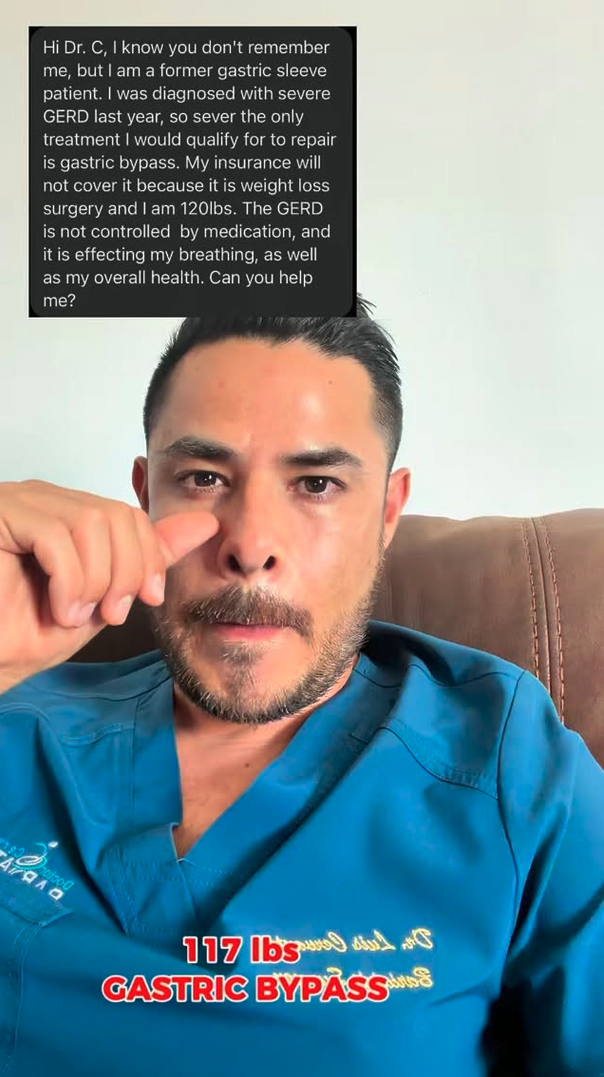
Watch Dr. Cervantes Explain
Want to hear more about how we evaluate complex revisional cases? In this quick Reel, Dr. Cervantes breaks down what you need to know before considering a second surgery.
Watch on InstagramIs Gastric Bypass an Effective Treatment for GERD After Sleeve?
For appropriately selected patients, conversion from sleeve gastrectomy to Roux-en-Y gastric bypass is one of the best-established revisional surgical strategies for severe GERD after sleeve.
Published evidence has demonstrated significant improvement in reflux symptoms and reduction in the need for anti-reflux medications following conversion. In a large multicenter study involving more than 2,000 sleeve-to-bypass conversions, GERD-related quality-of-life scores improved substantially, and anti-reflux medication use decreased significantly one year after conversion.
However, this point is extremely important: Gastric bypass does not guarantee that reflux will disappear. Some patients continue to experience GERD symptoms and require medication even after conversion. That is another reason why careful preoperative evaluation and patient selection matter.
But What If the Patient Has a Normal BMI?
This particular clinical scenario becomes much more challenging because the patient has already achieved substantial weight loss. At approximately 117 pounds and a BMI of 21.5, further weight loss is not the therapeutic objective. In fact, excessive additional weight loss would be undesirable.
If Roux-en-Y gastric bypass is ultimately considered, the indication would be treatment of a complication—not additional weight loss. The surgical strategy would need to consider:
- Current BMI and nutritional status
- Severity of GERD and objective findings
- Sleeve anatomy and hiatal hernia presence
- Long-term nutritional consequences vs. alternative treatments
Does Every Patient With Severe GERD After Sleeve Need a Gastric Bypass?
No.
And this may be the most important message in this article.
When I evaluate a patient like this, my first thought is not: “How can I convert this sleeve to a bypass?” My first thought is: “What is causing this patient’s reflux?”
If we identify a significant hiatal hernia, abnormal sleeve anatomy, severe esophagitis, Barrett’s esophagus, obstruction, angulation or another anatomical problem, that information may significantly influence our treatment strategy.
There are also alternative antireflux approaches being investigated or used in selected post-sleeve patients, particularly when BMI has normalized. Their suitability depends heavily on anatomy, physiology, available evidence and individual risk. The operation should follow the diagnosis—not the other way around.
What Would I Recommend for This Patient?
At this stage, I would not automatically recommend gastric bypass. I would first review her previous endoscopy, imaging and reflux testing, even if some of those studies are several years old to see how the problem developed.
After reviewing those records, our multidisciplinary team can determine which studies truly need to be repeated. Only then would I recommend a treatment strategy. Could Roux-en-Y gastric bypass ultimately be the appropriate operation? Yes. Could another approach make more sense? Also yes.
With a BMI of approximately 21.5, the objective is to identify the cause of her symptoms and determine the safest intervention capable of treating the problem while minimizing unnecessary nutritional and metabolic consequences.
The Right Revision Starts With the Right Diagnosis
Revisional bariatric surgery should never be simply: “You had a sleeve, so now you need a bypass.” Every previous operation changes anatomy. Every complication has a mechanism. And every revision introduces new consequences that must be considered.
My philosophy is simple: Understand the problem first. Choose the operation second.
If you have undergone gastric sleeve surgery and are now experiencing severe reflux, difficulty swallowing, weight recurrence or another long-term complication, a comprehensive revisional bariatric evaluation can help determine what is actually happening before deciding whether another operation is appropriate.
Frequently Asked Questions
Can gastric sleeve cause GERD years after surgery?
Yes. GERD can develop or worsen after sleeve gastrectomy, including years after the original procedure. Persistent or severe symptoms should be evaluated to determine whether there is an anatomical or physiological cause.
Can a gastric sleeve be converted to gastric bypass for severe GERD?
Yes. In appropriately selected patients, conversion from sleeve gastrectomy to Roux-en-Y gastric bypass is an established revisional option for medically refractory GERD.
Can someone with a normal BMI undergo gastric bypass for GERD?
Potentially. In unusual cases, the indication may be treatment of a complication rather than additional weight loss. Because further weight loss and nutritional consequences are important concerns, these patients require particularly careful evaluation and individualized surgical planning.
Does gastric bypass always cure GERD after gastric sleeve?
No. Many patients experience substantial improvement, but persistent reflux can occur after conversion. Appropriate diagnostic evaluation and patient selection remain important.
What tests are needed for severe GERD after gastric sleeve?
Depending on the individual case, evaluation may include upper endoscopy, contrast imaging, ambulatory pH or pH-impedance testing and high-resolution esophageal manometry.
Need a Professional Evaluation?
If you are experiencing severe reflux, weight regain, or other complications after a previous bariatric surgery, you don't have to guess what's wrong. Our specialized team is here to help you find the right diagnosis and the safest solution.