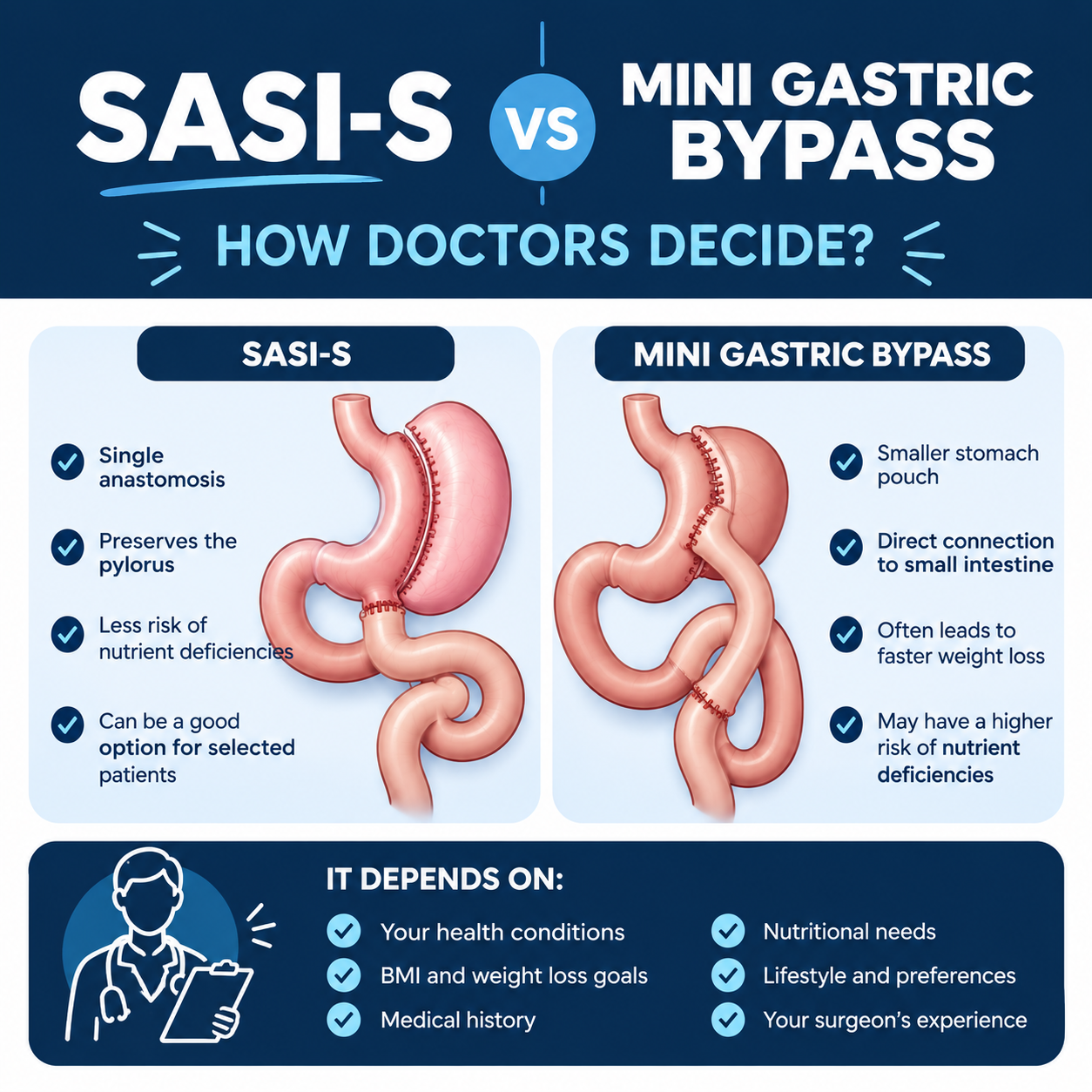
Gastric Sleeve to Gastric Bypass vs SADI-S: How Do Surgeons Decide?
When weight regain or complications occur years after a Gastric Sleeve (VSG), it is natural to start researching alternatives. Many patients arrive at our clinic in Tijuana already asking for a specific procedure: "Dr. Cervantes, I need a Bypass," or "I read about the SADI-S online, and I want that."
While being an informed patient is excellent, the decision between converting a Gastric Sleeve to a Roux-en-Y Gastric Bypass (RYGB) versus converting it to a SADI-S is not based on preference. It is a strict clinical decision based on your specific anatomy, the presence of acid reflux, and your metabolic goals.
Both procedures are incredibly powerful tools for revision, but they solve different mechanical and metabolic problems. Here is exactly how we, as bariatric surgeons, evaluate your anatomy to determine the safest and most effective path forward.
The Crucial First Step: Diagnostics Before Decisions
In revisional bariatric surgery, we never guess. Because your anatomy has already been altered once, we must understand its current state before planning a second operation. The decision matrix begins with testing.
- Barium Swallow Study: You drink a contrast liquid while we take X-rays. This shows us the exact size and shape of your current sleeve. We look for dilation (stretching), strictures (narrowing), and how fast your stomach empties.
- Upper Endoscopy (EGD): A camera is passed down your throat while you are asleep. This allows us to see the tissue directly. We are looking for esophagitis (inflammation from acid), a hiatal hernia, or a compromised esophageal valve.
The results of these two tests almost entirely dictate which surgical path we will take.
The Case for Gastric Bypass (RYGB): The Acid Reflux Cure
If your primary complaint is severe, daily heartburn, regurgitation, or waking up coughing, the decision is usually straightforward.
The Surgical Decision: If a patient has severe Gastroesophageal Reflux Disease (GERD) or a significant hiatal hernia after a gastric sleeve, the gold standard revision is conversion to a Roux-en-Y Gastric Bypass.
Why?
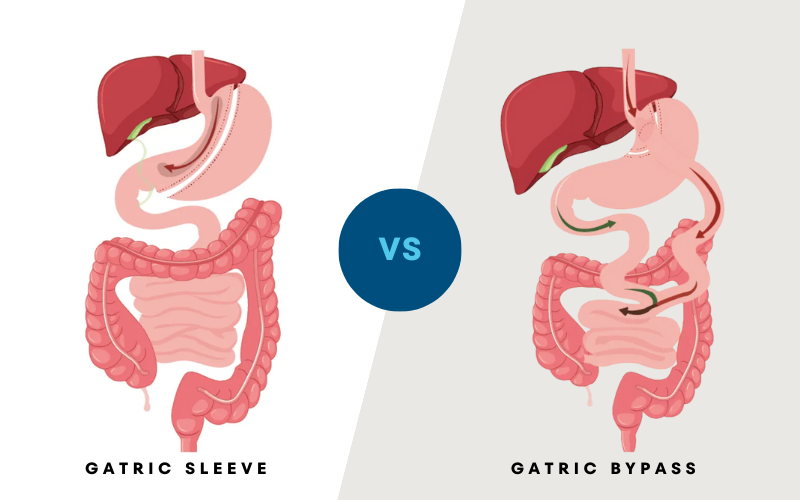
- Pressure Relief: A gastric sleeve is a high-pressure tube that forces acid upwards. A gastric bypass creates a tiny pouch that is a low-pressure system, relying on gravity to drain food and liquids quickly into the intestines.
- Acid Diversion: In a bypass, the acid-producing portion of the stomach is disconnected from the food stream. Bile and acid do not mix with your food until much lower in the intestines, making it physically nearly impossible for them to splash back up into your esophagus.
The GERD Rule
If you have severe, documented GERD, a SADI-S is generally contraindicated. The SADI-S preserves the high-pressure sleeve anatomy, meaning it will not cure your acid reflux, and it could potentially make it worse. The Bypass is the definitive mechanical cure for post-sleeve reflux.
The Case for SADI-S: Maximum Metabolic Power
What if your stomach has stretched, you have regained a significant amount of weight, or your Type 2 Diabetes has returned, but you have absolutely no acid reflux? This is where the SADI-S shines.
The Surgical Decision: The Single Anastomosis Duodeno-Ileal Bypass with Sleeve Gastrectomy (SADI-S) is often the procedure of choice for patients needing profound weight loss and metabolic correction, provided their esophageal valve is healthy.
Why?
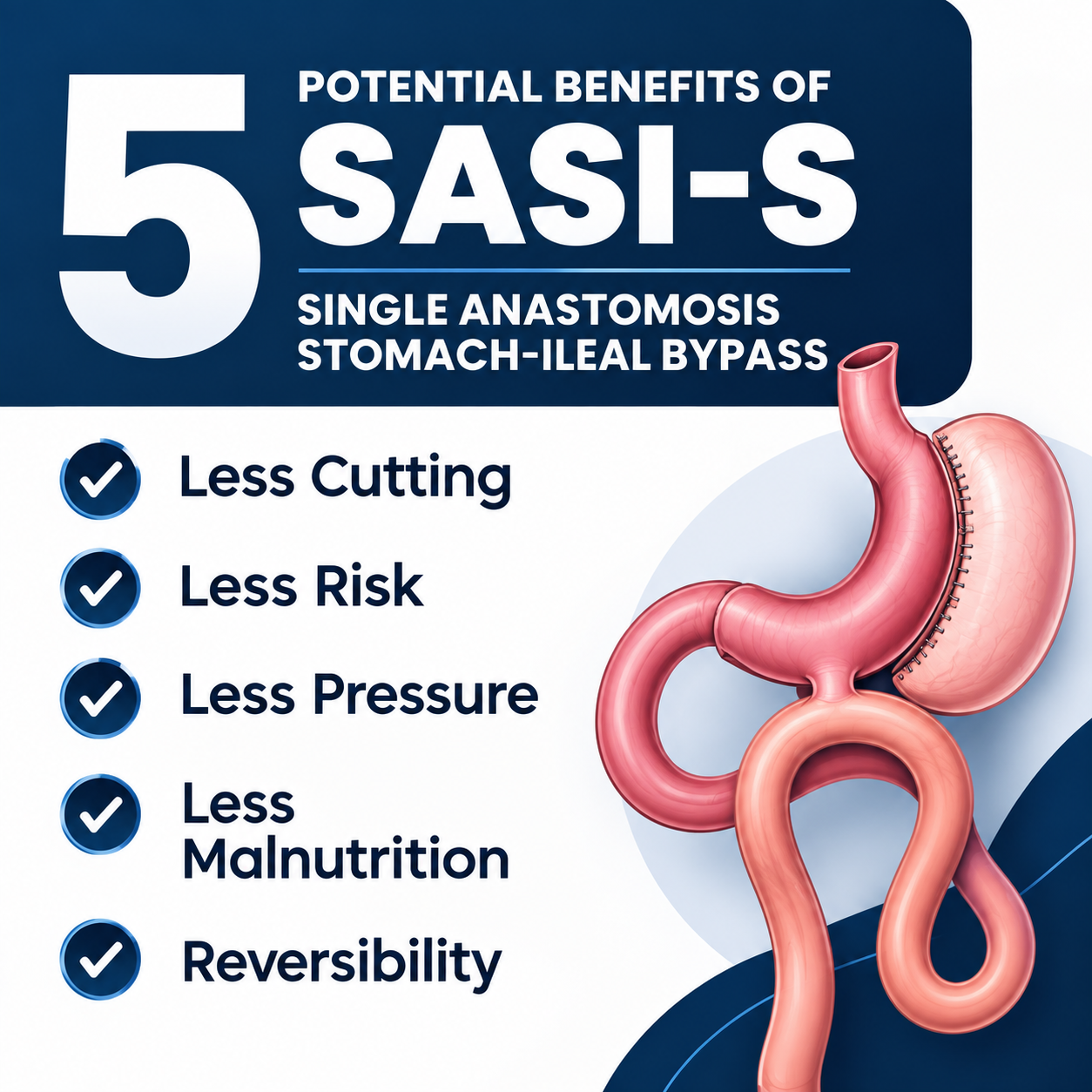
- Preserved Pylorus: Unlike the standard bypass, the SADI-S preserves the pyloric valve at the bottom of your stomach. This greatly reduces the risk of "Dumping Syndrome" (nausea and weakness after eating sugar) and allows for a slightly more normal eating experience.
- Powerful Malabsorption: The SADI-S bypasses a much larger portion of the small intestine than a standard RYGB. This means your body absorbs significantly fewer calories and fats. Studies consistently show that SADI-S offers superior long-term weight loss and higher remission rates for severe Type 2 Diabetes compared to a standard bypass.
The Surgeon's Decision Matrix
While every patient is unique, here is a simplified look at the clinical criteria we use to guide our recommendations during a consultation.
| Clinical Presentation | Recommended Revision | Reasoning |
|---|---|---|
| Severe GERD (Acid Reflux) + Weight Regain | Gastric Bypass (RYGB) | Bypass creates a low-pressure system and diverts acid, curing the reflux while addressing the weight regain. SADI-S is contraindicated. |
| Massive Weight Regain + No GERD | SADI-S | SADI-S provides superior malabsorption for greater total weight loss while preserving the pyloric valve to prevent dumping syndrome. |
| Severe Type 2 Diabetes Relapse + No GERD | SADI-S | The extensive intestinal bypass of the SADI-S offers the highest rate of metabolic correction and diabetes remission. |
| Stretched Sleeve + Minor Regain + No GERD | Re-Sleeve or GLP-1 Meds | If the anatomy is just slightly dilated and there is no reflux, trimming the sleeve or adding medical weight loss may be sufficient without intestinal rerouting. |
"You cannot choose a revision surgery based on a brochure or a friend's experience. We must choose the tool that fixes your specific anatomical and metabolic problem."
Frequently Asked Questions
Is SADI-S a more dangerous surgery than a Gastric Bypass?
Both are major revisional surgeries and carry similar baseline surgical risks. However, SADI-S involves more profound malabsorption. This means the risk of long-term vitamin and mineral deficiencies (like protein malnutrition or iron deficiency) is higher with SADI-S. Patients must be strictly committed to taking specialized bariatric vitamins for life.
Can a Bypass be converted to a SADI-S later?
Technically, complex revisions are possible in expert hands, but converting a standard Roux-en-Y Gastric Bypass into a SADI-S is incredibly difficult because the original stomach anatomy (the pyloric valve) has already been bypassed. It is much easier to convert a Sleeve to a SADI-S.
Will my stomach stretch again after a revision?
It is always possible for stomach tissue to stretch if a patient consistently overeats. However, because both the Bypass and SADI-S add a powerful "malabsorptive" (intestinal) component, your long-term weight maintenance does not rely solely on stomach restriction anymore, providing a much stronger safety net against regain.
Let's Find the Right Tool for You
Stop guessing which surgery you need. Let our specialized revisional bariatric team evaluate your anatomy, review your medical history, and map out the exact surgical path to reclaim your health safely.